Choosing the right size is one of the biggest decisions you'll make when purchasing a metal barn. A building that's too small can quickly become cramped, making it difficult to store equipment, move vehicles, or keep supplies organized. On the other hand, choosing more space than you need can increase the cost of your project without providing much practical benefit. So, what size metal barn do you actually need?
For North Carolina farmers and landowners, the answer depends on much more than the amount of equipment you own today. Around Mount Airy and Surry County, that may mean planning room for a tractor, hay, livestock supplies, and a farm workshop under one roof.
This guide will help you understand some of the most common metal barn size options and what each can offer. We'll also cover how to measure your equipment, plan for future needs, choose the right height and doors, and determine when a custom-size metal barn makes more sense for your North Carolina property.
Key Takeaways
- The right metal barn size depends on how you'll use the building, not just how much open land you have available.
- 30×40 barns offer 1,200 square feet and can work well for smaller farms, basic storage, and limited equipment.
- 40×60 barns provide 2,400 square feet, making them a versatile starting point for equipment, hay, livestock supplies, and general farm use.
- Larger buildings such as 40×75 and 48×60 provide additional room for equipment, storage, workshops, and growing operations.
- Measure your equipment before choosing dimensions, including width, length, height, attached implements, trailers, and required door clearance.
- Barn height and door dimensions are just as important as floor area, especially when storing tall tractors, hay equipment, trailers, and other large machinery.
- A custom-size building may be the best option when standard dimensions don't provide the layout, storage capacity, or equipment clearance your operation requires.
What Size Metal Barn Do I Need?
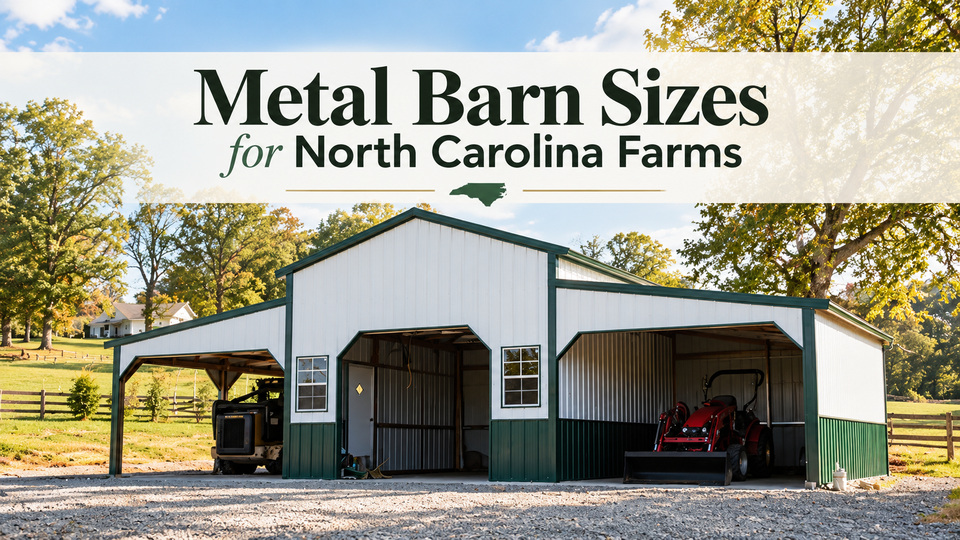
There's no single metal barn size that's right for every North Carolina farm. A small property used primarily for general storage may have very different needs from a working farm with tractors, trailers, hay equipment, livestock supplies, and multiple vehicles.
The following sizes can give you a starting point:
| Metal Barn Size | Floor Area | Best Starting Point For |
|---|---|---|
| 30×40 | 1,200 sq. ft. | Smaller farms, basic equipment, and general storage |
| 40×60 | 2,400 sq. ft. | Equipment, tractors, hay, livestock, and multi-purpose farm use |
| 40×75 | 3,000 sq. ft. | More equipment/storage space and larger agricultural needs |
| 48×60 | 2,880 sq. ft. | Larger equipment and multi-use storage |
| 50×50 | 2,500 sq. ft. | Flexible clear-span storage and workspace |
| Custom Size | Varies | Operations with specific equipment, storage, or layout requirements |
These dimensions are starting points rather than strict recommendations. Your actual requirements may lead you toward a smaller or larger structure.
How to Determine the Right Metal Barn Size for Your Property
Before choosing dimensions, think about how the building will actually be used. Base it around:
What You Plan to Store
Make a list of everything the barn may need to accommodate. This can include:
- Tractors
- Implements
- Hay
- Livestock supplies
- Trucks
- Trailers
- ATVs
- Tools
- Feed
- Workshop equipment
Don't forget smaller items. A barn can fill up surprisingly quickly when tools, feed, spare parts, fencing supplies, and other farm necessities are added around larger equipment.
It's also important to think about whether everything needs to be stored indoors. On a North Carolina farm, plan covered space for equipment, vehicles, feed, and supplies that need protection from rain. If you store hay, leave room for airflow and a layout that keeps bales away from ground moisture.
Measure Your Equipment
Once you've made your inventory, measure the equipment that will go inside. Important measurements include:
- Equipment width
- Overall length
- Equipment height
- Attached implements
- Trailer dimensions
- Door clearance
- Turning and maneuvering room
Don't measure equipment only in its parked position. Consider how much space you'll need to pull it into the barn, turn around, attach or remove implements, and access surrounding equipment.
For example, a tractor may fit through a door when measured by itself, but an attached implement could make the combination substantially wider or taller. Giving yourself additional clearance can make everyday use much easier.
Plan for Future Needs
A metal barn is a long-term investment, so don't base the entire decision on what you own today. Ask yourself:
- Will you add equipment?
- Will the herd grow?
- Will you store more hay?
- Will you need a workshop?
- Will you eventually add another vehicle or trailer?
If you expect your operation to grow, building a little additional capacity now can be more practical than discovering a few years later that you need another structure.
30×40 vs. 40×60 vs. 40×75: Which Metal Barn Size Fits Your Operation?
These three building configurations represent some useful points along the size spectrum. The right choice depends on how much equipment you have, how you plan to use the building, and how much room you want for future expansion.
30×40 Metal Barn
A 30×40 barn provides 1,200 square feet of floor area. That makes it a reasonable starting point for smaller farms, basic equipment storage, workshop space, or a combination of general storage and vehicle protection. A 30×40 can work particularly well when you have a limited amount of equipment or don't need to store multiple large machines under one roof. It can also be useful as an additional storage building on a larger property.
The main consideration is planning the interior carefully. Once you add tractors, tools, supplies, and other equipment, 1,200 square feet can disappear faster than expected.
“Want to see a real building configuration? View the 36×40×12 A-Frame Metal Barn and compare its layout with the size you have in mind.”
40×60 Metal Barn
With 2,400 square feet, a 40×60 barn provides twice the floor area of a 30×40 and substantially more flexibility than many smaller structures. It's a versatile option for agricultural properties that need room for tractors, implements, hay, vehicles, livestock supplies, or general storage. For many North Carolina agricultural operations, a 40×60 can provide a practical balance between usable space and overall building size.
40×75 Metal Barn
A 40×75 barn provides 3,000 square feet of floor area. That additional length can make a significant difference for operations that need to store more equipment or separate different uses within the same building. If you expect your operation to grow or already have several large pieces of equipment, a 40×75 may be worth considering over a smaller standard configuration.
“Comparing barn layouts for a growing farm? See the 36×35×15 All Vertical Raised Center Barn for another configuration to consider.”
When a Custom Size Makes More Sense
Standard metal barn dimensions are convenient, but they're not ideal for every property. Your equipment, property layout, storage needs, or future plans may require dimensions that fall outside common sizes. In those situations, going with a custom-size building can help you get more usable space instead of trying to force your operation into a standard footprint.
Custom sizing can make sense when you need to accommodate unusually large equipment, create separate work and storage areas, fit a building into a specific portion of your property, or maximize the usable space available on your site. For a property near Mount Airy or in the surrounding foothills, check the usable level area, drainage, and equipment access before settling on a footprint. Confirm setbacks and any permit requirements with the local planning or inspections office before ordering.
At Panhandle Metals, we offer an extensive array of building configurations, giving you the flexibility to customize your structure around your actual needs. Our team can help you compare building configurations and customization options based on your needs.
“Need a layout built around your equipment? Design your metal barn in 3D to explore the dimensions and features before requesting a quote.”
Don't Overlook Barn Height
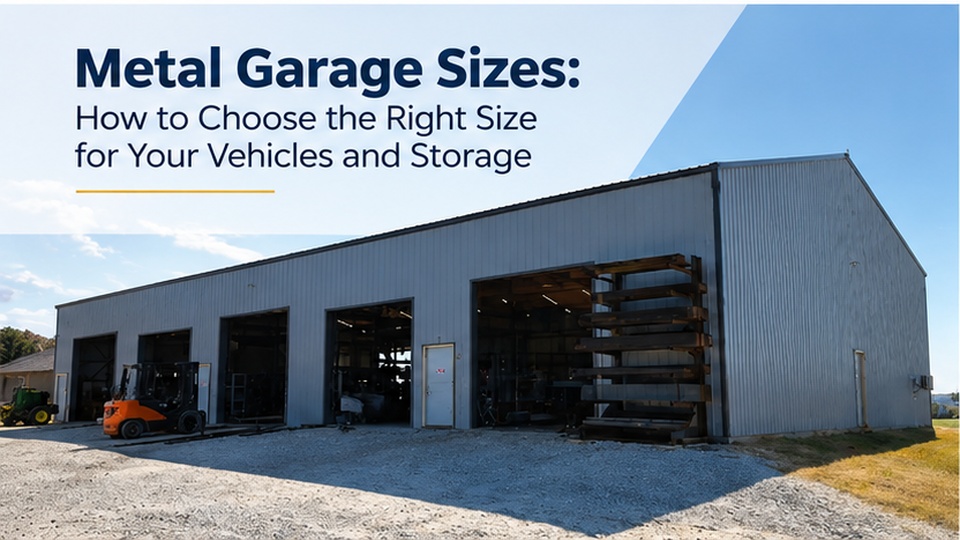
Width and length tend to get most of the attention when people shop for a metal barn, but height can be just as important. A building can have plenty of floor space and still be difficult to use if the roof clearance or door height isn't sufficient for your equipment.
When choosing your barn height, consider:
- Tractor height
- Hay equipment
- Trailer clearance
- Storage requirements
- Future equipment
Remember that equipment height can change when attachments are installed. A tractor with a loader, for example, may require substantially more vertical clearance than the tractor itself. It's generally better to determine your clearance needs before ordering the building than to discover afterward that your tallest equipment barely fits.
“Need more height for equipment access? Explore the 48×35×16 Metal Barn as an example of a taller building configuration.”
Door Size Matters Too
A metal barn's usefulness isn't determined by its floor area alone. The doors are one of the most important features because they determine how easily you can get equipment, vehicles, trailers, and supplies into and out of the building.
When planning your barn, consider the width and height of your largest equipment, along with additional clearance for comfortable operation. A door that technically fits a tractor may not provide enough room to enter easily or account for equipment that is slightly wider than expected.
Depending on your operation, you may want larger roll-up garage doors, additional walk-in doors, or custom framing for specific jobs. Multiple doors can also make it easier to move equipment through the building and access different areas without constantly repositioning machinery.
Why Choose Panhandle Metals for Your North Carolina Metal Barn
North Carolina farms come in all shapes and sizes, and your metal barn should be built around the way you actually work. Based in Mount Airy, NC, Panhandle Metals is a metal building dealer that can help you compare barn sizes and customize your layout. Discuss wind and snow load requirements for your specific site when requesting a quote; conditions vary across the mountains, Piedmont, and coast.
“Not sure which frame fits your project? Review the 12-Gauge vs. 14-Gauge Steel Framing guide before choosing.”
When planning your barn with Panhandle Metals, ask about:
- Delivery and installation in qualifying areas
- Site-specific structural requirements and available building options
- Customizable designs
- Flexible financing options
- Warranty coverage for your selected building
- Dedicated customer support
Whether you need a compact storage barn, a large equipment building, or a customized structure designed around your operation, Panhandle Metals can help you explore your options. Ready to find the right size metal barn for your North Carolina farm? Call Panhandle Metals today at (336) 203-6217 to discuss your needs and get started on your building.
Conclusion
Choosing the right metal barn size starts with understanding how you plan to use the building. Consider everything you'll store, measure your largest equipment, account for door and maneuvering clearance, and think about how your farm or ranch may change over the coming years.
Don't forget that height, door dimensions, and the overall configuration are just as important as floor area. A well-planned metal barn should make your daily work easier while providing enough room for your current needs and future growth.
Ready to choose the right size for your North Carolina farm? Call Panhandle Metals today at (336) 203-6217 and let our team help you design a metal barn that fits your operation.
Frequently Asked Questions
There isn't one universal size because every farm and ranch has different needs. A 30×40 can provide a useful starting point for smaller operations, while 40×60, 40×75, 48×60, and 50×50 configurations provide more room for equipment, storage, and multi-purpose use.
A 40×60 provides 2,400 square feet and can be a versatile option for many farms. Whether it is enough for your North Carolina property depends on your equipment, storage needs, and the access space left after everything is parked.
Your barn size should depend on your tractor's dimensions and whether you'll store it with implements attached. You'll need to consider the tractor's width, length, height, turning space, and the size of the door you'll use to bring it inside. It's also smart to leave additional room for future equipment.
The right size depends on bale dimensions, how much hay you intend to store, how it will be stacked, and whether other equipment will share the building. A 30×40 may work for a smaller hay inventory, but calculate the space your bales need before choosing. NC State Extension recommends dry storage conditions; plan to limit ground moisture and leave room for airflow and bale handling.
If you expect your farm or ranch to grow, additional space can be a worthwhile investment.
Yes. Height determines whether tall tractors, trailers, hay equipment, and other machinery can comfortably enter and operate inside the building.
Yes. Custom sizing can be useful when standard dimensions don't fit your equipment, property, storage requirements, or intended layout.