When choosing a metal building, the gauge of the panels is one of the specs worth understanding. 29-gauge and 26-gauge metal panels are both commonly used for metal roofs and walls, but they differ in thickness, weight, stiffness, cost, and resistance to dents and impacts. The right choice depends on how your building will be used and the conditions it needs to handle.
While 26-gauge panels are thicker and generally more resistant to impacts, 29-gauge panels can provide a practical option for many standard metal buildings. Other factors, including the building's framing, roof design, panel profile, fasteners, and engineering requirements, also affect overall performance.
This guide compares 29-gauge and 26-gauge metal panels so you can better understand the differences in thickness, weather resistance, cost, and common applications before choosing the right option for your build.
Key Highlights
- 26-gauge panels are thicker than 29-gauge panels and generally provide greater stiffness and dent resistance.
- 29-gauge panels are lighter and typically less expensive, making them a common choice for standard metal buildings.
- Gauge refers to the thickness of the steel, but actual thickness can vary by manufacturer and product.
- Both 26- and 29-gauge panels can be used for metal roofing and siding.
- Thicker panels can provide greater resistance to impacts, but panel gauge is only one part of a building's overall performance.
- Wind and snow resistance also depend on the building's engineering, framing, roof design, connections, anchors, and site-specific requirements.
- Panhandle Metals commonly uses 29-gauge panels with 14-gauge tubing on standard buildings while offering thicker options for custom projects.
Planning a metal building? Explore Panhandle Metals' custom metal building options or call (336) 203-6217 to discuss the panel and framing options available for your project.
What Does Gauge Mean on a Metal Panel?
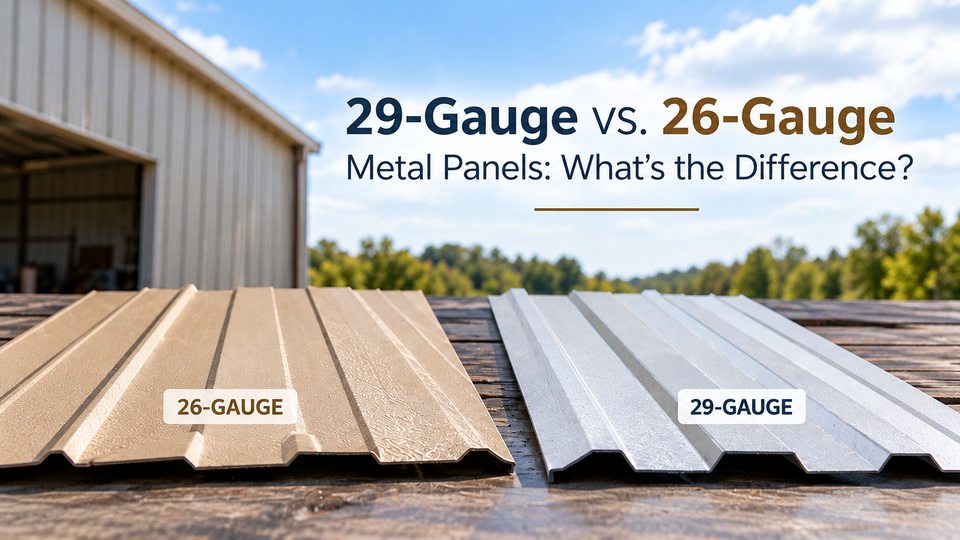
Gauge is a measurement used to describe the thickness of metal. With steel panels, a lower gauge number generally means a thicker panel, so 26-gauge steel is thicker than 29-gauge steel. However, gauge is not a universal thickness standard across every product. Actual thickness can vary by manufacturer, coating, and panel specification, making it important to review the product's stated thickness when comparing options.
29-Gauge vs. 26-Gauge Metal Panels
Both 29- and 26-gauge panels can be used for metal building roofs and walls, but the difference in thickness affects several characteristics.
| Feature | 29-Gauge Metal Panels | 26-Gauge Metal Panels |
|---|---|---|
| Thickness | Thinner | Thicker |
| Stiffness | Less rigid | More rigid |
| Weight | Lighter | Heavier |
| Cost | Generally lower | Generally higher |
| Dent Resistance | Good for typical applications | Greater resistance to dents and impacts |
| Common Applications | Garages, carports, workshops, agricultural buildings | Commercial buildings, higher-end structures, projects requiring heavier panels |
| Roofing Use | Common | Common |
| Wall/Siding Use | Common | Common |
The exact performance and pricing of either option will depend on the panel profile, steel specification, manufacturer, coatings, and building design.
See a real building configuration: View the 30x50x12 Metal Building to see an example of a Panhandle Metals building that uses 29-gauge panels.
What 26-Gauge Metal Panels Offer
For buyers looking for a heavier panel option, 26-gauge steel provides several advantages. Its additional thickness gives the panel greater rigidity and can provide additional resistance to dents and impacts. It also weighs more and generally costs more than 29-gauge material. For these reasons, 26-gauge panels are often considered for commercial, higher-end, or more demanding building applications.
In general, 26-gauge metal panels are:
- Thicker than 29-gauge panels
- Heavier, which can affect handling and installation
- Stiffer and more rigid
- Higher in cost than thinner panels
- More resistant to dents and impacts
- Commonly used in commercial and higher-specification applications
The added thickness can be useful when a project calls for a more substantial panel, but it doesn't automatically make 26-gauge the right choice for every building.
Is 26-Gauge Metal Paneling a Better Choice Than 29-Gauge?
A 26-gauge panel is thicker and generally offers greater resistance to impacts and physical damage than a 29-gauge panel. However, that doesn't mean it is automatically the better choice for every project. The right panel depends on your building's location, expected weather conditions, design requirements, intended use, and budget.
For example, a buyer may prefer the additional rigidity of 26-gauge panels for a building that will see frequent use or greater exposure to impacts. Another buyer may find 29-gauge panels provide the appropriate balance of performance and cost for a standard garage or storage building.
Which Gauge Is Better for Metal Roofing?
Both 26-gauge and 29-gauge panels are used for metal roofing systems. A thicker 26-gauge panel can provide greater resistance to dents and impacts, which may be useful in areas where the roof is more likely to experience physical damage.
However, the gauge of the roof panel is only one part of the equation. A roof's overall strength and weather performance also depend on its design and engineering. Factors such as the roof profile, framing, spacing, fasteners, connections, roof pitch, wind requirements, and snow loads all contribute to how the roofing system performs.
This is why choosing a thicker panel should be considered alongside the building's overall engineering requirements rather than as a standalone measure of roof strength.
If you're also comparing building roof configurations, review the available metal building roof styles before deciding on your final setup.
When 29-Gauge Roof Panels Make Sense
29-gauge roofing is a common choice for many standard metal buildings. It can provide a practical balance between durability and cost when the building does not require a heavier panel specification.
29-gauge roof panels may make sense when:
- You're building a standard garage or storage building with typical design requirements.
- Keeping project costs manageable is an important consideration.
- The building's engineering specifications are compatible with 29-gauge panels.
- Weight is a consideration during material handling and installation.
- The building will have typical residential, agricultural, or light-duty use.
- Your local wind and snow requirements do not call for a heavier panel specification.
- You want a durable metal roofing option without upgrading to a thicker panel.
Want to compare layouts before ordering? Use the Panhandle Metals 3D Designer to explore building configurations and customization options.
When 26-Gauge Roof Panels Make Sense
26-gauge roofing may be worth considering when the project calls for a thicker, more rigid panel. While it typically costs more, the additional material can provide increased resistance to dents and impacts.
26-gauge roof panels may make sense when:
- Greater panel rigidity is desired.
- The building may experience more frequent physical impacts.
- Hail or falling debris is a concern for the particular application.
- The project specifications call for a heavier panel.
- You're building a commercial or higher-specification structure.
- The additional cost fits within the project's budget.
- The building's engineering calls for 26-gauge panels based on its design or site requirements.
Metal Panels for Wind and Snow Load Resistance
Panel thickness can play a role in how a metal building performs under wind and snow loads, but it is only one part of a much larger engineering equation. A thicker panel may provide additional rigidity and resistance to certain types of damage, but the roof and wall system must work together with the building's structural frame.
Wind and snow performance can depend on factors such as building location, design, roof configuration, framing, panel profile, connections, anchors, and required load ratings. Site-specific engineering may also determine which materials and specifications are appropriate for a particular project.
For this reason, upgrading from 29-gauge to 26-gauge panels should not be viewed as a substitute for proper structural engineering. The appropriate gauge should be selected based on the requirements of the complete building system.
Before installation, buyers should also review Panhandle Metals' site preparation guidance and confirm local structural and permitting requirements for their property.
Questions to Ask Before Choosing a Metal Panel Gauge
Comparing 26- and 29-gauge panels is a useful starting point, but gauge is only one part of the specification. Before choosing a metal panel, ask the supplier for the details below. These questions can help you understand exactly what you're buying and how the panels fit into the building's overall design and engineering:
- What gauge are the roof panels?
- What gauge are the wall panels?
- What is the actual manufacturer-specified thickness?
- What coating or substrate protects the steel?
- What wind load is the complete building engineered for?
- What snow load applies?
- Is the building certified for my installation location?
- What panel warranty applies?
- Is the gauge standard or optional for this building system?
What Gauge Panels Does Panhandle Metals Use?
Panhandle Metals offers buildings configured with 29-gauge panels and 14-gauge tubing. This combination provides a practical option for many garages, storage buildings, workshops, barns, carports, and other common metal building applications.
For projects with different structural or design requirements, other panel and framing options may also be available depending on the specific building, location, manufacturer specifications, and engineering requirements.
Panhandle Metals is a metal building dealer based in Mount Airy, North Carolina, helping customers locally and nationwide find metal buildings for residential, agricultural, commercial, storage, vehicle protection, and other applications. Buyers can explore options including metal carports, metal barns, garages, RV covers, workshops, commercial buildings, and other custom structures.
The right combination depends on the specific building, its location, and the requirements of the project. Panhandle Metals can help you determine which panel and framing options make sense for your structure.
Ready to start planning your building? Call Panhandle Metals at (336) 203-6217 to discuss your project, or explore the available panel and trim colors while planning your design.
Conclusion
Choosing between 29-gauge and 26-gauge metal panels comes down to more than simply choosing the thicker option. 26-gauge panels offer additional thickness, rigidity, and dent resistance, while 29-gauge panels can provide a practical and cost-effective solution for many standard buildings.
The best choice depends on the building's location, use, weather requirements, engineering specifications, and budget. Understanding these differences makes it easier to compare your options and select a panel specification that fits the project.
Ready to compare your metal building options? Browse Panhandle Metals' metal buildings, design your structure with the 3D Designer, or call our building experts at (336) 203-6217.
Frequently Asked Questions
Yes. 26-gauge metal is thicker than 29-gauge metal. In the steel gauge system, a lower gauge number generally indicates a thicker material.
29-gauge steel is generally around 0.014 to 0.018 inches thick, depending on the specific steel product and manufacturer.
26-gauge steel is generally around 0.018 to 0.021 inches thick, depending on the product specification and manufacturer.
29-gauge metal can be suitable for many standard garages and other metal buildings. However, the appropriate panel gauge depends on the building's design, location, weather requirements, and engineering specifications. Panel gauge is also only one factor in determining the overall strength of a garage.
A thicker 26-gauge panel can provide greater rigidity and resistance to certain types of physical damage, but panel gauge alone does not determine a building's wind performance. Wind resistance depends on the entire engineered system, including framing, connections, anchors, roof design, and required wind loads.
Generally, the additional thickness of 26-gauge steel can provide greater resistance to dents from impacts, including hail. However, actual hail resistance depends on factors beyond gauge, such as the panel profile, steel properties, installation, and the size and force of the hail.
Not necessarily. Both can provide long service lives when properly specified, installed, and maintained. A 26-gauge panel's additional thickness can provide greater resistance to dents and physical impacts, but factors such as the coating, installation quality, environmental exposure, maintenance, and overall building design also affect service life.